
Booster Seats: What Age Is the Right Time to Switch?
I get it - a booster seems easier.
But is it really??
Sometimes parents are eager to move their child into a booster seat because it seems easier—no more buckles, fewer straps, and more independence for your child. But the truth is, transitioning too soon can actually make car rides less safe and less convenient. Knowing the right time to switch is key!
Have we met? Hi, I’m Kelly, The Car Mom—a mom of four and a Child Passenger Safety Technician (CPST). I’ve helped thousands of families figure out the best car seat setups for their kids, and one of the most common questions I get is: “At what age can my child use a booster seat?” Let’s walk through the answer.
If you’re looking for a full breakdown of booster seat requirements—including types of boosters, safety tips, and my top seat picks—check out my complete guide for booster seats right here.
First Things First - What Qualifies As A Booster Seat?
A car seat uses a 5-point harness to keep your child secure, while a booster seat relies on your vehicle’s seat belt.
The booster’s only job is to make the seat belt fit correctly: the lap belt should rest low on the hips and tops of the thighs, and the shoulder belt should lie across the chest and shoulder—not the stomach or neck.
Without that proper fit, the seat belt can’t do its job in a crash.
The booster’s job is to make sure the:
Lap belt sits low on the hips and touches the tops of the thighs, not the stomach.
Shoulder belt crosses the chest and shoulder, not the neck or face.
Something to remember: the seatbelt is just as safe as a harness when used properly!
Truth: Sometimes A Booster Seat Is More Challenging For Kids.
A lot of parents look forward to the booster stage because it feels like it will be simpler—no more dealing with a harness, just clicking in with a seat belt. But in reality, buckling up in a booster can still be tricky for kids since seat belt buckles can be hard to reach, depending on your car and where your seat belt buckles are located.
If convenience is the only reason you’re thinking of switching, just keep in mind that it still takes practice and supervision, and it shouldn’t outweigh whether your child is truly ready for a booster.
My Favorite Booster Seat Tips:
If your child struggles to buckle their seat belt in a booster, you can keep it buckled and have them slide in and out above the seat as long as the belt stays properly positioned across their shoulder and lap every ride.
We love a booster with LATCH because they stay secured to the car even when your child isn’t in them. If a booster doesn’t have LATCH, you’ll need to buckle it in when it’s empty, since a loose seat can turn into a dangerous projectile in a crash.
If your convertible toddler all-in-one car seat transitions into a booster, it’s completely safe to use it that way, but many parents find it easier to switch to a dedicated booster. By the time your child is ready, you’ve probably had your convertible car seat for years, and a standalone booster is often slimmer, lighter, and less bulky.
What Age Can a Child Move Into a Booster Seat?
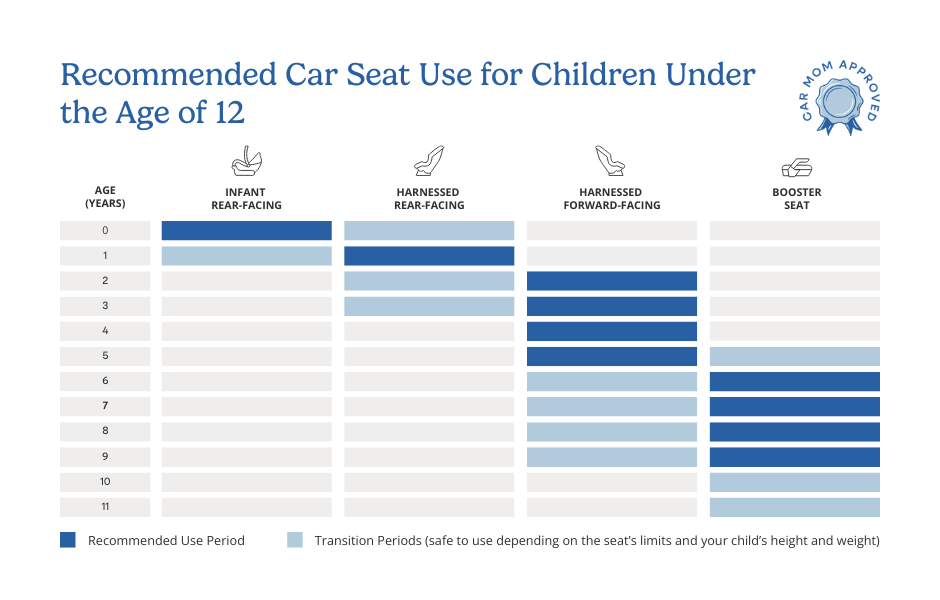
There’s no one-size-fits-all answer. While many parents assume booster seats are based on age alone, the truth is your child’s size, fit, and maturity matter more.
Typical age range: 5–7 years old.
Reality check: Age is just a guideline. The real milestone is when your child has fully outgrown their forward-facing car seat with a harness.
So, while your brother’s 5-year-old may already be in a booster, your 6-year-old might still need their harnessed seat for optimal safety (and that’s okay!).
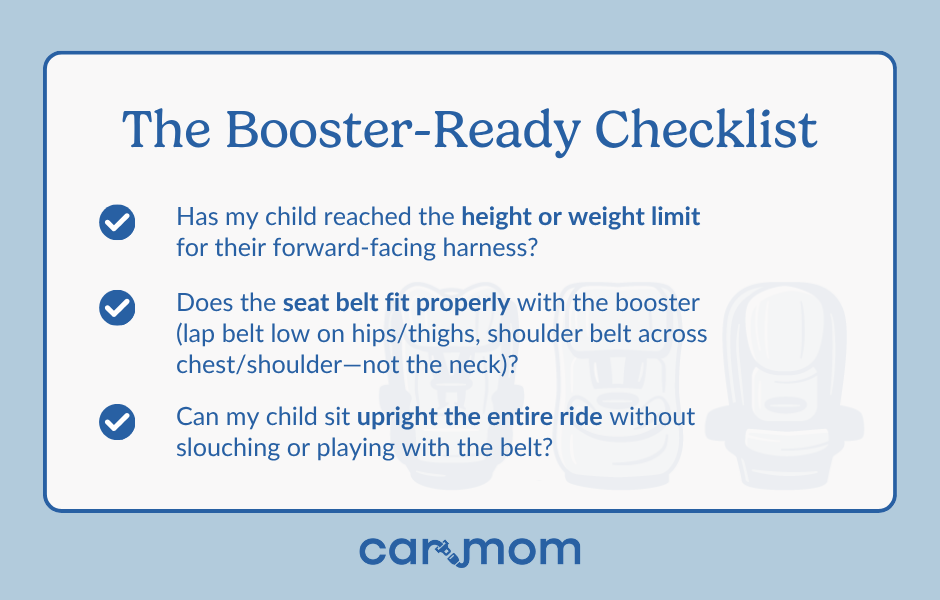
The Booster-Ready Checklist
Instead of asking just what age, ask yourself these readiness questions:
Has my child reached the height or weight limit for their forward-facing harness? Is the harness at or above their shoulders? (If it’s coming from below, the seat is outgrown!)
Does the seat belt fit properly with the booster (lap belt low on hips/ on tops of thighs, shoulder belt across chest/shoulder—not the neck)?
Can my child sit upright the entire ride without slouching or playing with the belt?
If the answer to all three is yes, your child may be ready. If not, keep them harnessed a bit longer (assuming they haven’t maxed out the height or weight of their current seat).
Types of Booster Seats
Choosing the right booster depends not only on your child’s readiness but also on your car and your family’s needs.
Combination Seats
Also called a convertible seat. Start forward-facing with a harness, and later convert to a booster.
Examples: Chicco Fit360, Graco SlimFit 3 LX, Nuna Rava. These are convertibles, and one is an all-in-one seat.
Forward-Facing Harness to Boosters
Start with a forward-facing harness and later convert to a high back booster. Some also convert to a backless booster.
Examples: Chicco MyFit, Graco Tranzitions, Graco Nautilus, Britax Grow With You Clicktight
High-Back Boosters
Provide head, neck, and torso support.
Examples: Chicco KidFit ClearTex, Diono Cambria, Peg Perego Viaggo Flex 120
Backless Boosters
Lightweight and portable
Require the vehicle to have adequate headrests.
Examples: Graco Turbo Booster LX
The Best Booster Seats (According to Me!)
For kids who are on the smaller side or closer to average height:
For bigger or older kids, my go-to has always been the Diono Cambria. It’s super roomy and has great height and weight limits, but it’s been so tough to find in stock lately. If you’re running into the same issue, here’s what I’d look for instead:
Aim for a high-back booster that goes up to at least 57 inches tall and up to 120 pounds. That way, you know it will support your growing kiddo for the long haul.
Of course, this is also dependent on your car and whether you have non-removable headrests. Please check the manual for proper installation.
If you need help choosing a seat for your specific child and car, we would love to help! You can book 1-1 time with our team right here.
Oops! Don’t Forget These…
Even if your child is the right age and size, booster safety comes down to proper use. Avoid these pitfalls:
Ignoring belt fit —The seat belt is only effective if it’s positioned correctly. The lap belt should always lie flat across the hips and upper thighs, never across the stomach.
Letting kids slouch or lean — Even in a booster, your child needs to sit upright the entire ride. Slouching, leaning to the side, or moving the belt behind their back puts them at risk because the seat belt can’t do its job properly.
Not buckling the booster when empty — A booster that isn’t buckled in can become a dangerous projectile during a sudden stop or crash. Even if your child isn’t riding in it, make sure the booster is buckled into the seat!
Don’t Rush the Transition
It might feel like your child is getting too big for their convertible seat, but keeping them in their current seat until they’ve outgrown it and are mature enough for a booster is your best bet. Keeping them harnessed until they’ve truly outgrown it isn’t just okay—it’s the safest choice!
Every child grows differently, so instead of focusing on “booster seat what age,” remember: the right time is when your child has the size, fit, and maturity to ride safely.
Moving your child into a booster is a big milestone, but it doesn’t need to be rushed. When in doubt, wait until they fully meet all the criteria. Proper fit and correct use matter far more than age alone. If you’re truly unsure whether it’s time, can we help with that?
With ChatCPST, you can get expert advice from our expert Certified Passenger Safety Technicians, delivered just like we’d share it with a friend. Whether you have questions about booster readiness, where the booster fits in your car, or making sure your setup is the safest option for your child, we’re here to give you the confidence and clarity you need.

What questions do you have about boosters? Are you gearing up for the switch? Tell us below!